"Doctor, Is It Too Late for Me to Get the Cervical Cancer Vaccine?"
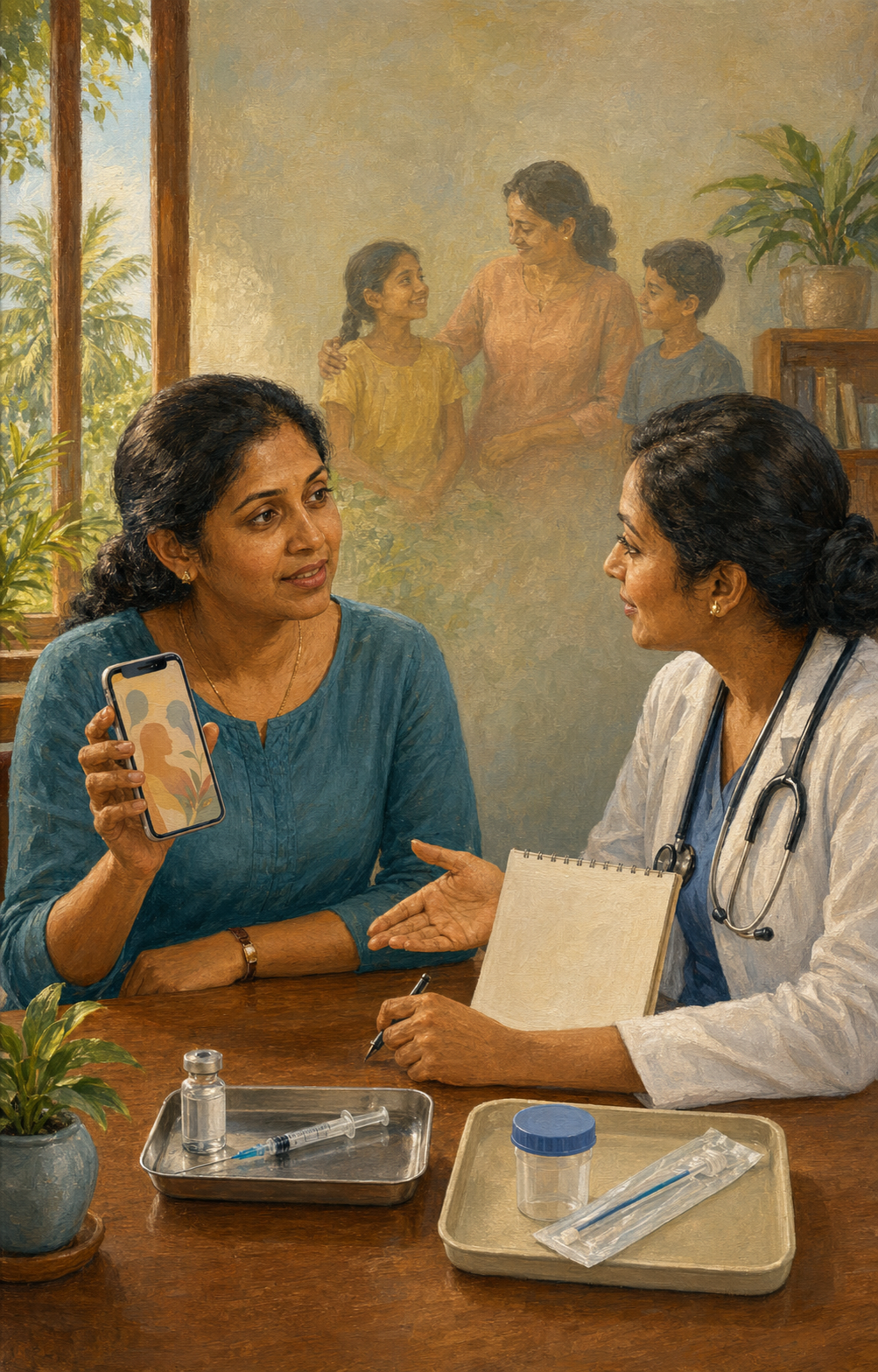

Mrs. Ruwanthi was 47 years old when she came to see me with a question that many women silently carry.
“Doctor, I saw a Facebook post about the cervical cancer vaccine. Should I get it too?”
It was a good question. In fact, it was more than a good question. It was the kind of question that can open the door to prevention, early detection, and sometimes even saving a life.
Many health decisions today begin with something seen on social media. Some posts create fear. Some create confusion. But sometimes, a post makes a person pause and ask the right question.
Mrs. Ruwanthi had done exactly that.
I told her, “The cervical cancer vaccine, also called the HPV vaccine, is a very important vaccine. It helps prevent infection with high-risk types of human papillomavirus, which are responsible for most cases of cervical cancer.”
She listened carefully.
“But doctor,” she asked, “is it too late for me?”
That question deserves a thoughtful answer.
What is HPV?
HPV stands for human papillomavirus. It is a very common virus. Many sexually active people may be exposed to HPV at some point in life. In most people, the body clears the infection naturally. But in some women, persistent infection with high-risk HPV types can slowly lead to changes in the cervix. Over many years, these changes can progress to cervical cancer if they are not detected and treated early.
This is why cervical cancer is different from many other cancers. We know the main cause. We have a vaccine to prevent many HPV infections. We also have screening tests, such as the Pap smear and HPV DNA test, to detect early changes before cancer develops.
That means cervical cancer is largely preventable.
Why is the vaccine given to schoolgirls?
Mrs. Ruwanthi then said, “I heard this injection is given to schoolgirls.”
“Yes,” I told her. “That is correct.”
The HPV vaccine works best when given before a person is exposed to HPV. This is why many countries, including Sri Lanka, give it to girls at school age, before they become sexually active.
Some people misunderstand this. They think giving the HPV vaccine to young girls is connected to sexual behaviour. It is not. It is about cancer prevention.
We do not wait for someone to be bitten by a rabid animal before explaining the value of rabies prevention. We do not wait for someone to develop liver disease before explaining hepatitis vaccination. In the same way, the HPV vaccine is best given early, before exposure.
It is a preventive vaccine, not a treatment.
Should boys also receive the HPV vaccine?
Mrs. Ruwanthi then asked another important question.
“Doctor, should boys also get it?”
This is an important public health discussion.
HPV is transmitted through intimate sexual contact. Men can carry and transmit HPV even when they have no symptoms. HPV can also cause cancers in men, including anal, penile, and some throat cancers. Vaccinating boys can protect them and also reduce transmission to women.
So yes, from a prevention point of view, HPV vaccination is not only a “girls’ issue.” It is a family, community, and public health issue.
When boys are vaccinated, they are not only protected themselves; they also become part of protecting future partners and future families.
Is it too late at 47?
This was Mrs. Ruwanthi’s main worry.
At 47, the benefit of HPV vaccination is not the same as giving it to a young girl before sexual exposure. The vaccine prevents new HPV infections. It does not treat an existing HPV infection. It does not treat abnormal Pap smear results. It does not cure cervical cancer.
For younger people, especially before sexual exposure, the benefit is highest.
For adults who are older, the benefit depends on individual circumstances, such as previous vaccination status, sexual history, future risk of new exposure, and the type of vaccine available. Some adults may still benefit, while for others the benefit may be small.
So the answer is not simply, “Too late” or “Definitely take it.”
A better answer is: “Let us discuss your individual risk and decide together.”
This is where a family doctor can help. Prevention should be personalised. The vaccine is important, but it should be understood properly.
Have you done your Pap smear?
I then asked Mrs. Ruwanthi another question.
“Have you done your Pap smears?”
She looked slightly embarrassed.
“No doctor, I haven’t.”
This is very common. Many women are aware of blood pressure, diabetes, cholesterol, and breast problems, but cervical screening is often delayed or forgotten. Some women feel shy. Some are afraid. Some do not know where to go. Some think screening is only needed if they have symptoms.
But cervical screening is most useful before symptoms appear.
A Pap smear is a simple test that looks for early abnormal changes in the cervix. These changes can often be treated before they become cancer. HPV DNA testing may also be used to detect high-risk HPV infection.
In Sri Lanka, cervical cancer screening is available through Well Woman Clinics, MOH services, government hospitals, and also in the private sector. Women should not wait until they have bleeding, pain, discharge, or other symptoms.
Screening is prevention.
Vaccine and Pap smear are not enemies
Some people think, “If I get the HPV vaccine, I do not need Pap smears.”
This is not correct.
The HPV vaccine is a powerful protective tool, but it does not replace cervical screening. Vaccines protect against the most important cancer-causing HPV types, but no vaccine removes the need for screening completely. Screening detects early changes. Vaccination reduces the risk of those changes developing in the first place.
The best approach is not vaccine or screening.
The best approach is vaccine and screening.
For young girls, HPV vaccination is a major step toward preventing cervical cancer in the future. For adult women, especially those who have not had regular screening, Pap smear or HPV testing is essential.
Why do women avoid Pap smears?
In practice, many women delay cervical screening for understandable reasons.
Some feel shy. Some are afraid of pain. Some worry about what the result may show. Some believe they are not at risk because they have only one partner. Some assume that if they have no symptoms, everything must be normal.
But cervical cancer can develop silently over many years.
A Pap smear is usually quick. It may feel slightly uncomfortable, but it should not be severely painful. The few minutes of discomfort are small compared with the value of early detection.
A woman should never feel ashamed to ask for cervical screening. It is a normal part of women’s healthcare.
The message for mothers
There is another important lesson in Mrs. Ruwanthi’s question.
Many mothers are willing to do anything for their children, but they delay their own health checks. When the HPV vaccine is offered to daughters through school programmes, parents should understand its value and support it.
The vaccine is not a permission for early sexual activity. It is not a moral issue. It is not something to be feared because of misinformation.
It is cancer prevention.
Parents should ask questions, understand the vaccine, and make informed decisions based on medical evidence rather than rumours.
The message for fathers and sons
Cervical cancer prevention should not be left only to women.
Men must also understand HPV. Fathers should support vaccination for daughters. Parents should also understand the value of vaccinating boys where available and appropriate. Husbands should encourage their wives to attend screening. Sons should grow up knowing that prevention is part of responsibility.
Women do not get cervical cancer in isolation from society. Prevention requires family support, public health support, and honest conversations.
What I told Mrs. Ruwanthi
I told her, “At your age, the most urgent thing is to arrange cervical screening. You should do your Pap smear or HPV test. Regarding the HPV vaccine, we can discuss your individual situation and decide whether it is useful for you. But please do not delay screening.”
She nodded.
Sometimes the most important part of a consultation is not writing a prescription. It is helping a patient understand what matters most.
For Mrs. Ruwanthi, the Facebook post had done something useful. It had brought her to the clinic. It had started a conversation. It had opened the door to screening and prevention.
A simple message
Cervical cancer is one of the cancers we can do a lot to prevent.
The HPV vaccine protects against the virus that causes most cervical cancers. It is best given before sexual exposure, which is why school-age vaccination is so important. Boys also have a role in HPV prevention, and vaccinating boys can protect both men and women.
But adult women must remember another truth: vaccination does not replace Pap smears or HPV testing.
If you are eligible for cervical screening, please do not delay it. If your daughter is offered the HPV vaccine, take time to understand it and protect her future. If you are an adult wondering whether the vaccine is still useful, speak to your doctor.
Prevention begins with a question.
For Mrs. Ruwanthi, that question was simple:
“Doctor, should I get it too?”
And from that question came a larger message for all of us:
Cervical cancer prevention is not only about one injection or one test. It is about awareness, vaccination, screening, and the courage to talk openly about women’s health.
Factbox
WHO emphasizes that HPV vaccination and cervical cancer screening should be scaled up together; vaccination does not remove the need for screening. Sri Lanka’s National Cancer Control Programme states that Pap smear/HPV DNA screening is recommended at 35 and 45 years under the national programme, and screening is available through public services. Sri Lanka’s HPV programme gives HPV vaccine to Grade 6 girls / age 10–11 years, usually as two doses. For adults, many international guidelines recommend routine HPV vaccination through age 26, with individualized shared decision-making for ages 27–45; after 45, benefit is generally more limited and should be discussed case by case.